The Woman Who
Raced the World

Publicity photograph, c. 1889 · public domain
As it happened.
Elizabeth Jane Cochran left New York in November 1889 with one small travelling bag. You'd know her better by her pen name: Nellie Bly.
She wanted to go around the world in under eighty days, the same number Jules Verne had made up for a novel a few years earlier.
Her paper gave her seventy-five.
She did it in seventy-two.
“No one but a man can do this.”
New York, November 1889.
The idea was ridiculous.
A woman wanted to travel around the world, alone, mostly by steamship and train, in under eighty days.
Her editor said no. "No one but a man can do this," he told her.
"Very well," she said. "Start the man, and I'll start the same day for some other newspaper, and beat him."
She'd already made a name as an investigative reporter, the kind who'd get herself committed to an asylum for ten days just to write about what she found inside.
The whole thing was lifted straight from a novel. Jules Verne's fictional Phileas Fogg had circled the globe in eighty days, and Bly wanted to know if someone could pull it off, carrying nothing but what she could hold in two hands.
She left on the Augusta Victoria, a steamship out of Hoboken, and reached London seven days later. Someone asked her on deck if she got seasick. "That was enough," she wrote. "I flew to the railing."
Back home, readers of the New York World got something new: her exact location, wired ahead by cable and printed within days. The paper ran her progress like a soap opera, one column at a time, for months.
Suddenly, this wasn't a journey anymore.
It was a race.
“The Other Woman Is Going to Win.”
In Hong Kong, Bly stopped at the steamship office to book her next leg. The clerk told her she'd already lost.
"Lose it? What do you mean?" she asked, sure he'd gone mad.
"Aren't you having a race around the world?"
"The other woman is going to win," he said. "She left here three days ago."
That was the first Bly heard of Elizabeth Bisland - a writer for Cosmopolitan, sent the opposite way around the globe. Bisland hadn't wanted to go; she'd turned her editor down before he talked her into it.
The Route
- New YorkNov 14, 1889
- London
- Paris
- Brindisi
- Port Said
- Colombo
- Singapore
- Hong Kongthe race is revealed
- Yokohama
- San Francisco
- New YorkJan 25, 1890
The Last 24 Hours
January 25, 1890. New Jersey.
Bly finally arrived, seventy-two days after she'd left.
Her paper had chartered a special train to rush her home from San Francisco - flowers in the car, telegrams and cheering crowds at every stop. She called it "a ride worthy a queen."
Bisland, racing her the other way around the planet, arrived four days later - slowed by a rough Atlantic crossing on the way back from England.
The Board Game
The day after she arrived, The World published a board game built around the race: 73 spaces, with Bly, Jules Verne, a steamship, and a train all on the board.

"Round the World with Nellie Bly," the board game based on her race.
NY World, Jan 1890 · LOC ppmsca.02918
Odds and Ends
She stopped in Amiens to meet Jules Verne, the man whose novel had inspired the whole trip. He told her, "If you do it in seventy-nine days, I shall applaud with both hands."
The New York World turned her journey into a contest: readers guessed her exact finishing time, with a free trip to Europe as the prize.
She packed absurdly light for 1889 - one small bag, no trunk, no spare dresses.
Waiting in Hong Kong for her connecting ship, she bought a pet monkey and brought it the rest of the way home.
1889, while she travelled
That year, George Eastman began selling the first flexible roll film - the start of modern photography.
The Eiffel Tower had opened in Paris that May, the centerpiece of a World's Fair Bly passed straight through.
That September, Wyoming became the first state to grant women the right to vote.
That July, The Wall Street Journal published its first issue.
That September, a small Kyoto company called Nintendo was founded, originally making playing cards.
The Rest of Her Life
She married the industrialist Robert Seaman in 1895, and after he died in 1904, ran his manufacturing company herself. She patented a milk can and a stacking garbage can under her own name; her company also began producing the steel barrel credited as the model for the modern 55-gallon oil drum.
She returned to journalism in the 1910s - covering the women's suffrage movement, then reporting from the war zone between Serbia and Austria during World War One, one of the first foreign correspondents to do so.
She died of pneumonia in 1922, at 58.
The Portrait
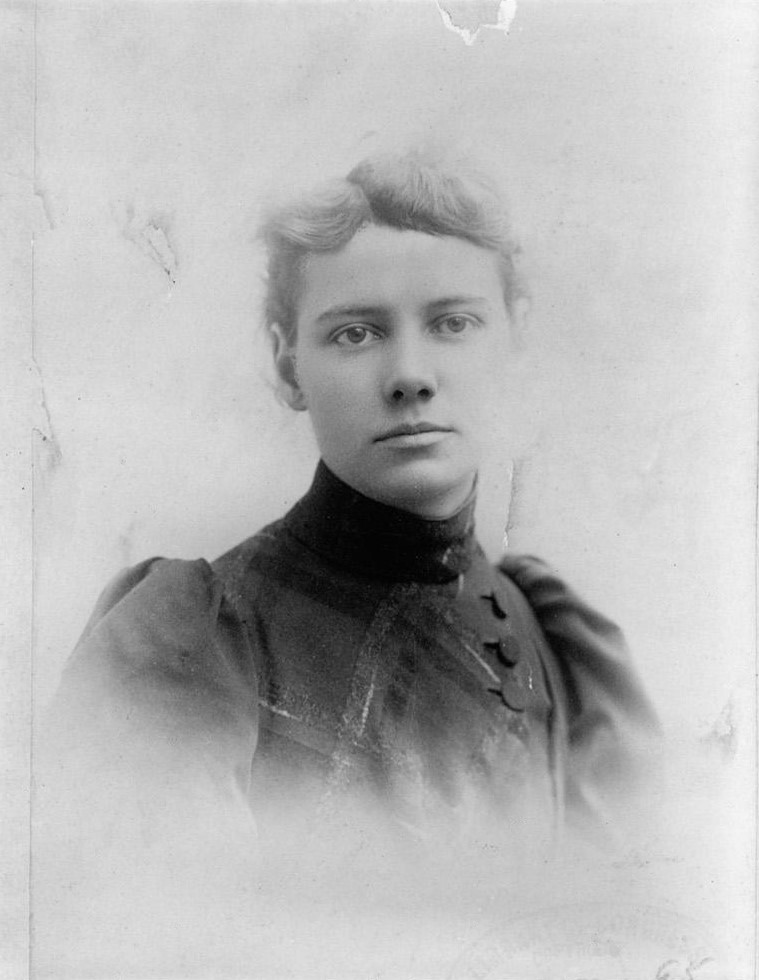
The same dress she travelled around the world in.
H.J. Myers, N.Y., c. 1890 · LOC cph.3c36891
The Postcard
Nellie Bly crossed the world in 72 days.
Primary Sources
- Nellie Bly's contemporary reporting, New York World, 1889–90
Archives
- Library of Congress (cph.3c36891, ppmsca.02918), via Wikimedia Commons
Further Reading
- To be finalized before print
Issue 001 is the sample. The real one gets the exact quoted dispatch and the actual contents of Nellie's bag, before the first real mailing goes out.